How to Price Balcony Options for a Double Storey Expandable Container House
How to Price Balcony Options for a Double Storey Expandable Container House
Why Balcony Option Pricing Needs a Clear Scope
Balcony options in a double storey expandable container house are usually priced as extras rather than part of the standard house body. To compare quotes fairly, you first need a clear delivery boundary: what the balcony includes, what is shipped separately, what is finished on site, and which costs fall to the destination side. Without that scope, two quotations that look similar may cover very different work, and the cheaper one may leave important items out.
Start from your usage goal and delivery boundary, then verify the specific model, drawings and site conditions. Treat the packaging and on-site assembly boundary as your first checkpoint, and review the pricing within the overall space, budget and maintenance plan. This gives you comparable numbers instead of a judgment based on a photo only.
You can start by reviewing ANTENG double storey expandable container house product information, then use the points below to price balcony options.
What the Balcony Option Includes
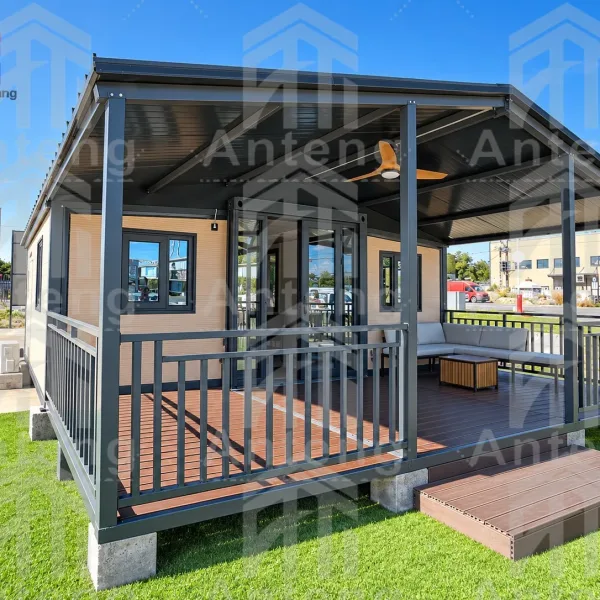
A balcony option can cover the platform or decking, supports, railings, drainage, threshold connection, steps, protective pieces and finish. Each item should be listed separately so the price can be traced back to a part. A balcony and a porch are not the same scope: a balcony is an open outdoor platform, while a porch usually acts as a sheltered stopping area by the entrance. Keep the two measured and priced apart, and check whether either adds separate packaging or on-site installation work.
If the list only uses a general term such as outdoor area, ask the supplier to break it down into body, attachments, materials and site work. Items that need local purchase or construction should be recorded separately, so they are not hidden inside a standard configuration name.
Material and Configuration Pricing
Balcony price changes with the material and the configuration. Decking type, railing style, finish grade and drainage fittings each carry their own cost. State the material name, model, installation layer and applicable condition instead of a commercial name that can be read differently. A sample finish does not prove performance, and one material test does not represent the whole balcony system. Record which option level each quote corresponds to, so the comparison is between like configurations.
For optional items such as upgraded railings, extra steps or planter spaces, mark when the selection must be made. Parts that need reserved space should not be decided after production starts.
Packaging and Freight
Clarify which balcony parts are shipped assembled, which are packed separately, and how they are protected in transit. Long rails, decking panels and supports can require extra packaging, and that cost should appear in the quotation rather than being assumed. Check whether the balcony option adds to the overall freight size or weight, and whether it needs its own shipping bundle.
Ask which parts the factory finishes, which stay protected in transit, and which are connected again on site. The interface covers not only the joint, but also sealing, trim and the equipment services around it.
On-Site Assembly and Installation
Separate the factory-finished work from the on-site assembly and installation. Record who provides the tools, who carries out the on-site fixing, and whether local installation labor is included. If the balcony needs anchors, sealant, trim or consumables on site, list them with responsibility and quantity. A low goods price that leaves all installation to the local side may not be the lowest total cost.
Interface and Foundation Costs
The balcony connects to the house body and often to a platform or foundation. Check the interface position, what it connects to, the required parts and how it is checked. On site, the foundation, leveling and any support posts may be local work with their own cost. Confirm whether the current quotation covers these, and keep site work separate from factory pricing.
If on-site drilling or fixing is required, confirm the equipment and people conditions before shipping. If the factory should reserve the fixing point, do not move it freely after arrival.
Compare Quotes on the Same Basis
Compare quotations only under the same model and finished condition. Match each item across quotes: platform, railings, drainage, threshold, packaging, freight, destination fees, foundation and installation. Keep three kinds of items in the budget sheet: already quoted by the factory, logistics still pending, and site work still to be calculated. When prices differ, trace the difference to a specific part or scope instead of comparing a full option against a basic one.
Write a Clear Pricing Requirement Brief
The brief can start with destination, use, balcony size, local wind and snow conditions, and site conditions, then list the pricing questions you want the factory to answer. Verify the first unit before fixing the list, drawings and handover records for the batch. If you provide reference photos, mark the specific balcony part you want to borrow, so the supplier does not read every furniture piece or accessory in the picture as part of the standard delivery.
Give both confirmed and still-open information. Confirmed facts set the pricing baseline; open items are where you ask for a few comparable suggestions. If the budget is not fixed yet, state your configuration priorities instead of asking the supplier to guess an acceptable range.
Fix the Delivery Scope with a Configuration List
Suggest listing the main body, balcony platform, railings, drainage parts, supports, protective pieces, installation consumables and on-site services separately. Everything visible in a picture is not necessarily included in the same quotation. The list can use four states: included, not included, optional and pending confirmation, linked to drawing numbers.
Factory Prefabrication and Site Work
Factory manufacturing can complete part of the processing and assembly in advance, but whether the balcony installs smoothly still depends on the early documentation and site conditions. The clearer the prefabrication scope, the easier it is for the overseas team to plan their own work. Ask which parts need trial fitting, which positions depend on site dimensions, and which work must be finished before packing. After preassembly, still account for transport protection and a check on arrival.
Inspection, Handover and Maintenance
Acceptance should cover the states that can actually be checked. The factory can verify manufacturing and preassembly, the handover can check packaging, and the finished site can verify the balcony interface, drainage and fixings. Each stage has a different purpose; record its scope and condition, and do not let a pass in one stage replace the work due in another.
After delivery, check whether railings, drains and fixings stay accessible for tightening, cleaning and replacement. Keep maintenance records tied to the specific house and configuration, noting what was observed, the condition at the time and the action taken.
Final Balcony Pricing Checklist
Before comparing quotes, make sure:
• Every balcony part is listed with its scope and responsibility
• Material, option level and finish match across quotations
• Packaging, freight and destination fees are separated
• On-site installation, foundation and consumables are recorded
• Interface and threshold costs are clearly assigned
• Budget, drawings and handover records are consistent
For more information about ANTENG double storey expandable container houses, please visit our product page or contact us for configuration consultation. The final purchase should be based on the model documents, confirmed drawings, supply list and the agreement between both parties.